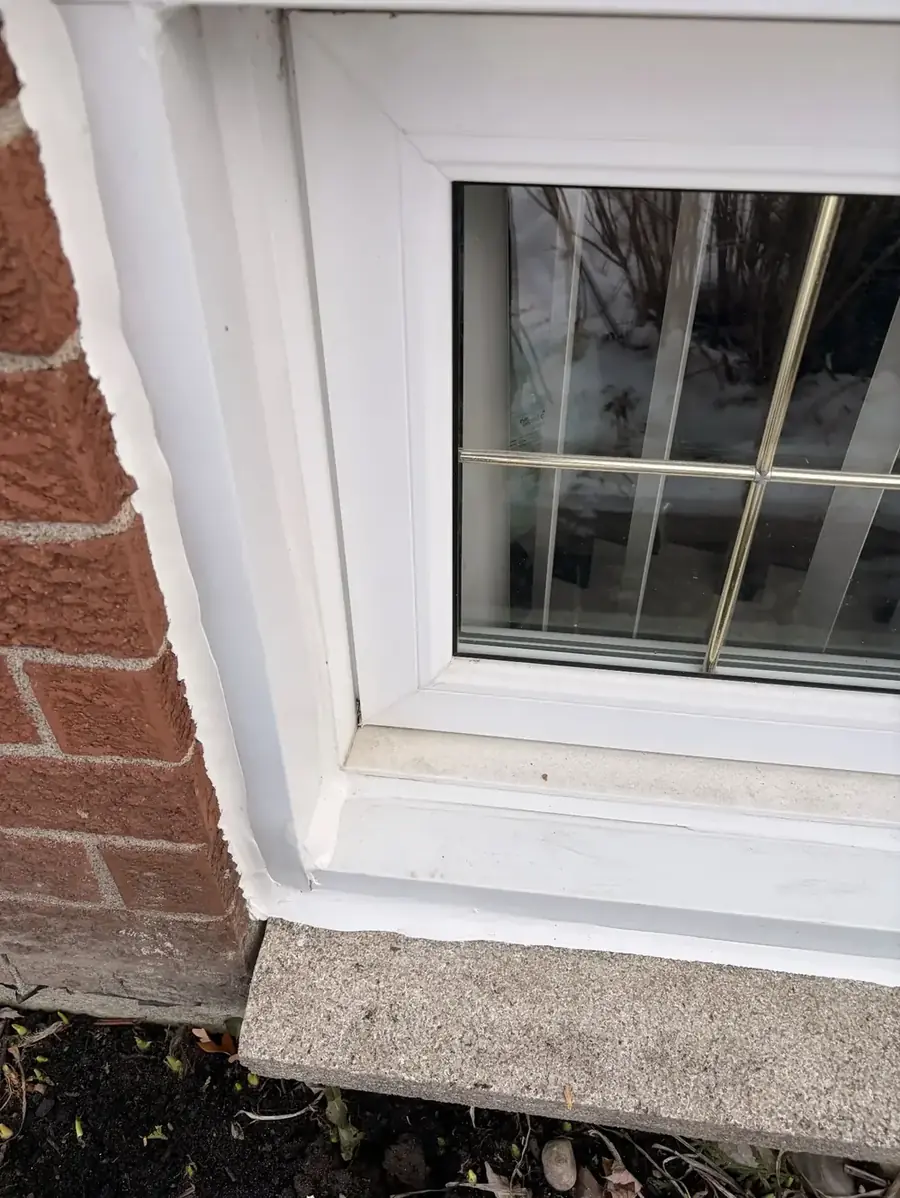
Yes. New sealant has to bond to a clean surface, not to an old joint that's hardened or cracked. Caulking over it hides the problem for a while, then the new joint ends up peeling off along with the old one.
Why we don't caulk over the old joint
A sealant only holds as well as whatever it's bonded to. If the old joint comes away from the frame or the brick, the new one goes with it. You pay twice for the same result.
There are other reasons:
- **Adhesion.** New sealant bonds poorly to old caulking that's dry, dusty or chalky. It bonds even worse to leftover silicone.
- **Trapped water.** Behind a cracked joint, there's often moisture or dirt. A layer on top seals it in instead of letting it out.
- **Joint shape.** A good joint has a precise thickness and shape so it can follow the frame's movements. A layer added over the old one makes the joint too thick and lumpy, and it performs poorly.
- **Appearance.** A joint applied over another one shows. The edges are uneven and dirt clings to it faster.
What it ends up costing
Caulking over the old joint seems faster and cheaper. But when the joint fails, everything has to come off: the old sealant, the added layer and the residue in between. It takes longer than doing it right in the first place.
Meanwhile, water may have gotten in behind the joint. A leak around a window isn't always visible right away. By the time you notice it inside, the problem has often been going on for a while.
How we remove old caulking
Removal takes a few steps:
- **Cut.** We slice the old joint along the frame and along the siding with a blade.
- **Remove.** We pull out the entire bead, along its full length.
- **Scrape.** We remove the residue stuck to the frame, brick or Canexel without damaging the surfaces.
- **Clean.** We remove dust and residue so the new sealant bonds directly to the material.
- **Check.** The joint must be dry. In a deep joint, we often add backer rod, a foam cord that gives the sealant the right shape.
It's the longest step in a caulking job. It's also the one that decides whether the joint will hold.
Doing it yourself?
It's possible, but plan for the time. Old hardened sealant resists, especially in the corners. You have to be careful not to scratch an aluminum or vinyl frame, or chip the brick.
The most common trap: leaving a thin layer of old silicone, thinking it'll do. The new joint looks great that day, then peels off right there. Our article How to caulk properly covers the basics if you want to try.
For a brick joint or an entire wall, access and volume often make the job simpler to hand off. See our page on brick joint caulking.
Can you keep an old joint that's in good shape?
Yes, if the joint doesn't need to be redone. Caulking that's still flexible, well bonded on both sides, with no cracks or holes, can stay in place.
But as soon as a joint is redone, it comes out completely. You don't fix a cracked joint by adding a layer on top. To find out if yours has reached that point, read 5 signs it's time to recaulk.
How we do it
At Protek, we always fully remove the old sealant before applying anything. We clean, prep the joint, then apply DOWSIL CWS silicone and tool it neatly. The details are on our window caulking page.
The best time to caulk is now, whatever the season. We apply down to −29 °C, on a dry surface free of frost and ice. Our winter caulking page explains how we work in cold weather.
As for price, expect $30 to $60 per standard window, or $3 to $8 per linear foot. The exact price is confirmed at the inspection. Our caulking price guide explains what makes a quote vary.
In short
- Yes, old caulking has to come off before new caulking goes on.
- Caulking over it hurts adhesion and can trap water.
- Complete removal, cleaning and prep decide whether the joint will hold.
- An old joint that's flexible and well bonded can stay in place.
- We caulk in every season, down to −29 °C on a dry surface.
Are your joints cracked or peeling? The inspection and quote are free, and we get back to you within 24 h. Call us at 438-405-4195. 12-month interest-free financing, subject to credit approval (iFinance) is also available.