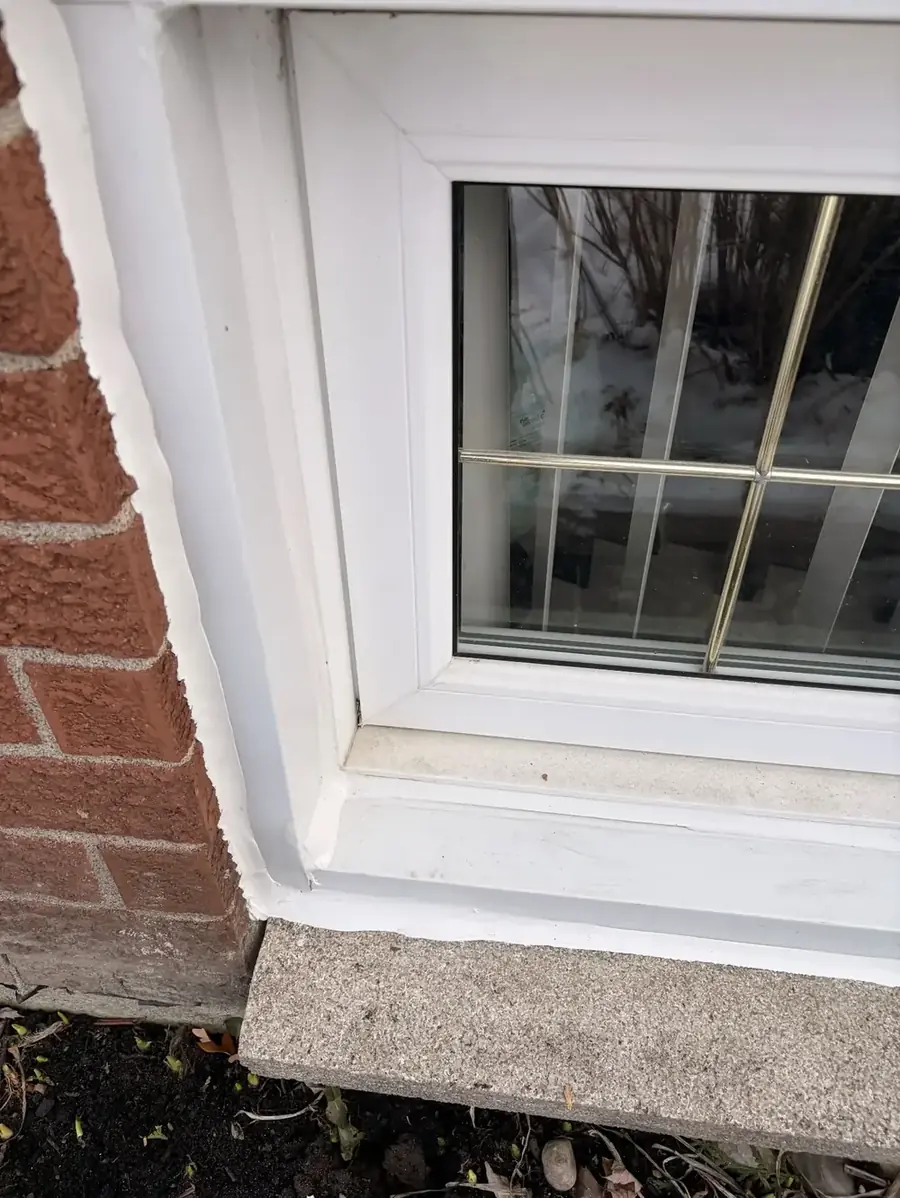
If the frame and glass are in good condition and the problem is the joint between the window and the wall, caulking solves it for a fraction of the cost. If the frame is rotten or warped, or the opening mechanism no longer works, caulking won't save the window. Here's how to tell the difference.
What caulking does—and what it doesn't
Exterior caulking seals the joint between the window frame and the wall cladding: brick, Canexel, vinyl or stone. This joint keeps water, air and insects from getting in around the window.
It doesn't repair the window itself. It won't fix a fogged insulated glass unit, worn weatherstripping, a rotten frame or a broken crank.
So the first question is simple: is the problem around the window, or in the window?
Signs the joint is the problem
- The exterior sealant is cracked, hardened, peeling or missing in places.
- There's a visible gap between the frame and the brick or cladding.
- The draft comes from the window perimeter, not the part that opens.
- Water marks appear below the window or in the corners after wind-driven rain.
- The frame and glass are sound, and the window opens and closes properly.
In these cases, replacing the caulking is the right solution. Our article on the 5 signs it's time to recaulk explains what to look for.
Signs the window is reaching the end of its life
- The frame is rotten, soft to the touch or split. This is common in older wooden frames.
- The frame is warped, making the window difficult to operate or close properly.
- The mechanism, hinges or crank are broken, and replacement parts can't be found.
- Air gets between the opening sash and the frame, even with new weatherstripping.
- There's condensation between the two panes of glass.
That last point needs a closer look. Condensation between the panes means the insulated glass unit's seal has failed. This isn't a caulking problem, and it doesn't always mean replacing the entire window: often, only the insulated glass unit needs replacing. See our page on insulated glass replacement.
A rotten frame, on the other hand, won't hold sealant. Caulking over it only hides the problem for a while.
What about the cost?
Caulking a standard window generally costs between $30 and $60, or $3 to $8 per linear foot. The exact price is confirmed at the inspection, based on access, the joint's condition and the type of cladding. Our caulking price guide explains what affects a quote.
Replacing a window costs considerably more, including installation. If the window is still in good condition, replacing only the joint is almost always the most economical choice. And a properly installed joint lasts a long time: our article on how long caulking lasts explains what that depends on.
The calculation changes when several windows are nearing the end of their life and you plan to replace them soon. In that case, recaulking around those windows doesn't make much sense.
What if you're replacing the windows anyway?
A new window also needs an exterior seal around its perimeter. Ask the installer whether exterior sealant is included in the quote, and which product they use.
Even a high-performance window lets water and air through if the joint is poorly done. The joint matters just as much as the window.
A note: Protek doesn't install windows. We do caulking. If your windows are in good condition, that's often all they need.
How we assess your windows
During the inspection, we check the joint and frame on each window. If a frame is too damaged to hold sealant, it's better to know before starting the work.
When caulking is the right solution, we completely remove the old sealant, clean and prepare the joint, then apply DOWSIL CWS silicone and tool it neatly. You'll find all the details on our window caulking page.
In summary
- Cracked or peeling joints, or drafts around the window perimeter: caulking.
- Condensation between the panes: insulated glass replacement, not caulking.
- A rotten or warped frame, or a broken mechanism: window replacement.
- A window in good condition: replacing the joint is almost always the most economical option.
- A new window: the exterior joint still needs to be done properly.
Not sure whether to caulk or replace your windows? The inspection and quote are free, and we get back to you within 24 h. Call us at 438-405-4195. Financing at 0% interest over 12 months is also available.