
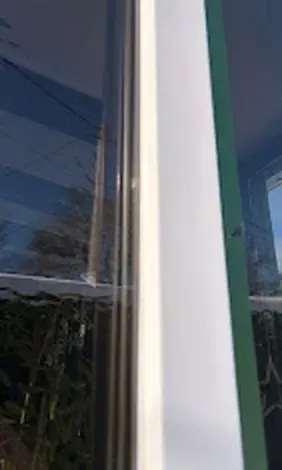
Often, yes, it's the caulking: a cracked or loose joint between the frame and the wall lets rain in. But water can also get through the brick, the sill, the window's drainage holes, or even come from inside. Before redoing anything, you need to find where it's getting in.
Signs of a water leak
Watch for:
- stains or rings on the drywall or plaster below the window or in the corners;
- paint bubbling or peeling around the frame;
- swollen, stained or blackened interior trim;
- water on the inside sill after rain;
- a damp smell or mould near the window.
Timing is a good clue. If the problem shows up after rain, especially wind-driven rain, the water is probably coming from outside. If it shows up in cold weather, with no rain, think condensation instead.
When it's the caulking
The exterior joint between the frame and the wall is the first barrier against water. Over time, the sealant hardens, cracks and pulls away. Water then follows the frame and gets into the wall.
From outside, check for:
- cracks in the joint;
- a gap between the sealant and the frame, or between the sealant and the wall;
- missing pieces of joint, especially in the corners and at the bottom of the window;
- sealant that is hard, cracked or crumbling.
If you see that, the caulking is a serious suspect. Our article 5 signs it's time to recaulk gives more clues.
At Protek, we always remove all of the old sealant. We clean, prepare the joint, then apply DOWSIL CWS silicone and tool it smooth. The details are on our window caulking page.
When it's something else
Redoing the caulking doesn't fix everything. Other causes are common:
- **Mortar joints.** Cracked or eroded mortar around the window lets water into the wall. Sealant doesn't replace mortar: that takes a mason. We caulk the joint between the brick and the frame. See brick joint caulking.
- **The sill.** A cracked or poorly sloped sill sends water back toward the house. The joint between the sill and the frame can be caulked. A broken sill is a different job.
- **The window's drainage holes.** Many windows have small openings at the bottom of the frame to let water out. If they're clogged with dirt, water builds up and can overflow inside. A good cleaning is sometimes enough.
- **Weep holes.** These small openings at the bottom of a brick wall let out the water that gets behind the brick. If they're blocked, the water stays in the wall. Never caulk them.
- **The window itself.** A worn weatherstrip, a warped frame or a broken part is a window issue. Our article Caulk or replace your windows: how to decide? helps you decide.
- **Higher up the wall.** An overflowing gutter or a problem above the window can let water in higher up. It then comes out at the window.
Condensation is not a leak
Water on the inside of the glass in cold weather is the moisture in the house condensing on a cold surface. Exterior caulking won't fix that. Look instead at the humidity level in the house and the ventilation.
If the fog is between the two panes, the sealed unit's seal has failed. That's not a caulking problem: see our page on sealed glass replacement.
How to find the source
A few simple steps before you call:
- Note when the water appears: during rain, in high wind, in cold weather.
- Look closely at the exterior joint, all the way around the window.
- Check the mortar, the sill, the drainage holes, the weep holes and the gutter above.
- If you spray the window with a hose to test it, do it section by section, with someone inside. Never use a pressure washer.
When in doubt, have it inspected. During our free inspection, we examine the caulking and tell you honestly if the problem seems to come from somewhere else.
We caulk in every season, down to −29 °C, on a dry surface with no frost or ice. The best time to caulk is now, whatever the season, and we always have room for a new project. As for price, expect $30 to $60 per standard window, or $3 to $8 per linear foot. The exact price is confirmed at the inspection. See our caulking price guide.
In short
- A cracked or loose joint is a common cause of leaks around a window.
- Mortar, the sill, drainage holes, weep holes and the gutter can also be to blame.
- Water on the glass in cold weather is condensation, not a leak.
- Fog between the panes means the sealed unit.
- Find the source before getting repairs done.
Water getting in around your windows? The inspection and quote are free, and we reply within 24 h. Call us at 438-405-4195.